01
The map
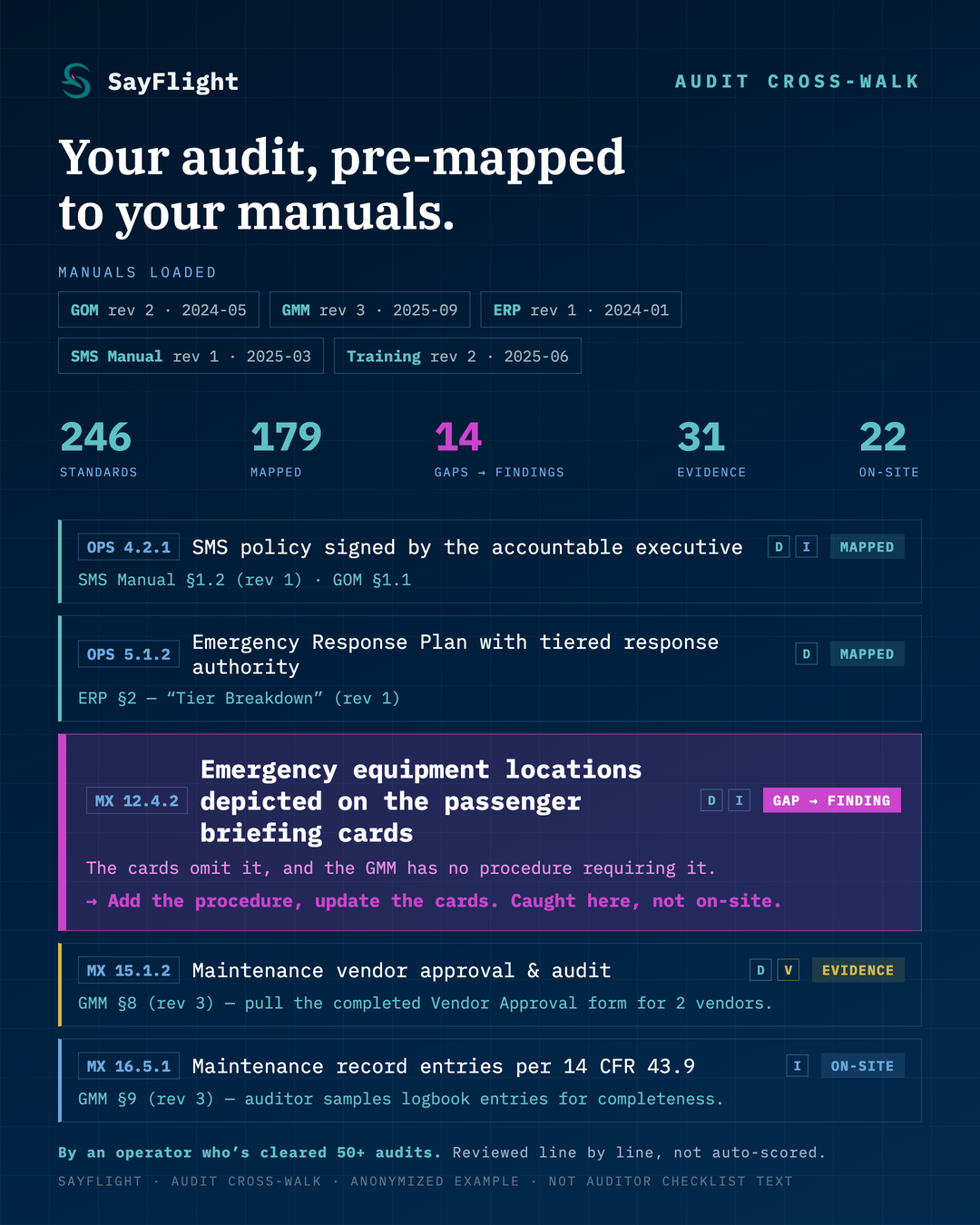
Every requirement in the checklist, tied to the exact section of your manuals where you meet it. GOM, GMM, ERP, SMS, PTM, SOPs, whatever your manual system includes. Section by section, revision by revision.
Audit Cross-Walk
You know what the month before an audit looks like. Somebody, usually the Director of Safety, or the COO wearing that hat too, spends nights walking the checklist line by line against your manuals. Where does the GOM cover this. Is that revision still current. What will they ask to see.
The Audit Cross-Walk does that month before the auditor arrives. Every requirement mapped to your manuals. Every gap flagged while there is still time to fix it. It takes roughly 80% of the preparation off your plate.
Four artifacts, built from your manuals against the standard you are being audited to.
01
Every requirement in the checklist, tied to the exact section of your manuals where you meet it. GOM, GMM, ERP, SMS, PTM, SOPs, whatever your manual system includes. Section by section, revision by revision.
02
The requirements your documents do not currently answer, flagged as documentation, implementation, or vendor gaps, while there is still time to close them. Caught in preparation, not on site.
03
The pull-list of records the auditor will ask to see, staged before anyone sits across the table. No hunting through folders with the clock running.
04
The short list of items that can only be verified physically, handed to your team to confirm before the audit. Honest about what a document review can and cannot see.
An anonymized example of the deliverable.
Four steps. Your manuals never move without an agreement in place.
Step 1
Before any document moves. Your manuals are handled with data minimization, under commercial data-protection terms. Where AI participates, it participates under SayFlight's own Operational Decision Architecture: never consumer AI accounts, and every judgment stays human.
Step 2
The current revisions of the documents your audit covers. That is the whole ask; your team keeps running the operation.
Step 3
Every line mapped, every gap classified, every judgment reviewed by a human operator. Not auto-scored. The deliverable records how it was produced.
Step 4
We go through the map together: what to fix, what to stage, what your team verifies on site, and how to answer for each requirement when the auditor asks.
I have been on the operator's side of more than 50 audits across multiple Part 135 operations: FAA, TSA, DOT (including drug and alcohol), workers' comp, a major-carrier codeshare, and the third-party safety rating programs. I led operations to ARGUS Platinum, Wyvern Wingman PRO, and IS-BAO Stage III.
At one operation we reached the point where the auditor came back with zero findings and asked us to write one up so his report did not look soft. That kind of ready is a process. The Audit Cross-Walk is that process, built on SayFlight's Operational Decision Architecture.
The default engagement works alongside your Director of Safety and takes the mapping and gap-hunting off their plate. Their judgment stays in charge; the grunt work leaves their desk.
For operators without that capacity, I can step in, carry the preparation, and support the operation through the audit itself. Audit preparation is also one of the lenses of the Diagnostic Sprint.
Have an audit on the calendar this year? Send one chapter of your GOM or GMM and see what the cross-walk catches. No cost for the look.
Start the conversationA map from every requirement in an audit checklist to the exact place in your own manuals where that requirement is met. Auditors work from this kind of instrument during the audit. This is the operator-side version, built before they arrive.
Third-party safety rating audits such as ARGUS, Wyvern, and IS-BAO, plus FAA, DOT, and TSA audit preparation. The cross-walk is built against your manuals and the standard you are being audited to.
Automated tools upload documents and return a score. Most requirements are not black and white; whether a manual section genuinely meets the spirit of a requirement is a judgment call. Every line here is reviewed by a human operator who has made those calls under audit. Reviewed, not auto-scored.
NDA before any document moves. Data minimization throughout. Where AI participates in the work, it participates under SayFlight's own Operational Decision Architecture: commercial data-protection terms, never consumer AI accounts, every judgment made and reviewed by a human. The deliverable records how it was produced.